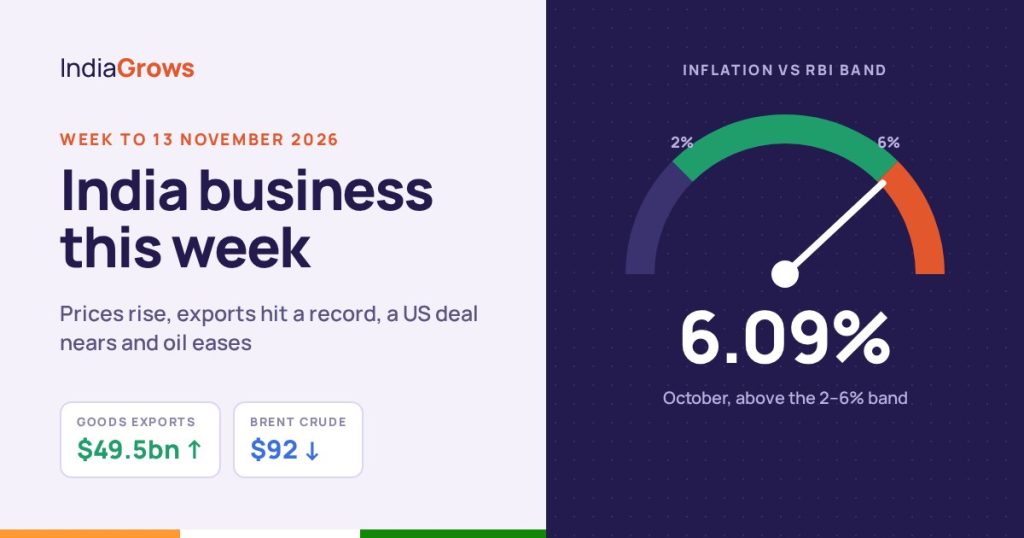
Inflation in India has climbed above the Reserve Bank of India’s comfort zone for the first time in about two years, just as exporters posted their best month on record. Ministers also said a US–India trade deal could be announced soon, and oil prices have fallen back sharply since late October. Here is what happened in the week to 13 November 2026 and what it means for diaspora businesses and families.
At a glance
- Inflation: 6.09% in October, up from 5.54% in September and above the RBI’s 2–6% tolerance band. Food inflation reached 8.94%.
- Exports: goods exports hit a record US$49.47 billion in October, up 45% on a year earlier.
- Trade deficit: the overall goods-and-services gap narrowed to US$20.09 billion, but the goods-only gap widened to US$39.88 billion, a one-year high.
- US–India trade deal: Commerce Minister Piyush Goyal said on 13 November that an announcement could come “quite soon”.
- Oil: Brent crude was around $92 a barrel on 13 November, down from around $115 two weeks earlier.
1. Inflation breaks above 6%
Official figures released by the Ministry of Statistics and Programme Implementation (MoSPI) on 12 November showed consumer price inflation at 6.09% in October (provisional), up from 5.54% in September. The RBI’s target is 4%, with a tolerance band of 2% to 6%, so October is above the top of that band. Reports called it the highest reading in about two years.
- Food: food inflation rose to 8.94% from 7.74%. Onions, garlic, ginger and lemons saw the biggest price rises.
- Villages and towns: inflation was 6.63% in rural areas and 5.41% in urban areas.
The RBI raised its repo rate (the rate at which it lends to banks) to 5.50% on 7 October, as we covered in our roundup of 27 October. Its Monetary Policy Committee next meets from 2 to 4 December. Economists at SBI Research and Bank of Baroda have said they expect another rise in December.
What it means: another rate rise is now a real possibility. That would push up the cost of business loans and floating-rate home loans in India. It could also mean better rates on rupee deposits, including NRE and NRO accounts held by non-resident Indians. Rising prices also squeeze the margins of businesses that sell to Indian consumers, especially food businesses.
2. Record exports, but a wider goods gap
Commerce Ministry figures released on 13 November showed India’s goods exports at US$49.47 billion in October, up 45.06% from US$34.11 billion a year earlier. Trade Secretary Rajesh Agrawal said it was India’s highest-ever monthly figure for goods exports.
- Goods imports also rose, to US$89.35 billion, so the goods trade deficit widened to US$39.88 billion, its highest in a year. That was more than the US$32.25 billion economists had forecast in a Reuters poll.
- Services filled much of the gap. Services exports are estimated at US$40.51 billion against imports of US$20.72 billion.
- Overall, combined goods and services exports rose 29.9% to US$89.99 billion, and the overall trade deficit narrowed to US$20.09 billion from US$25.15 billion a year earlier.
What it means: overseas demand for Indian goods is strong. The new trade deals with the UK and New Zealand are now in force, so this is a good time for diaspora importers and distributors to review their Indian suppliers. India’s strength in IT and other services exports continues to cushion its large import bill.
3. US–India trade deal: “quite soon”
An Indian official said on 10 November that talks with the US on the first tranche (stage) of a trade deal were continuing, after US officials visited India earlier this month. The latest discussions centred on customs and trade facilitation. In Visakhapatnam on 11 November, Commerce and Industry Minister Piyush Goyal said India would have “one of the best deals with the US”. On 13 November he told Business Today TV that “you could hear the announcement quite soon” and that only a few issues remain.
Mr Goyal also repeated India’s red lines. India will not open its dairy sector or allow genetically modified (GM) farm products under its trade agreements. The US Ambassador to India, Sergio Gor, said earlier this month that the deal had been “at the finish line for a very long time”.
What it means: nothing has been signed and there is no date, so current US tariffs on Indian goods still apply. Our article Is a US–India trade deal finally close? explains the background and what to prepare.
4. Oil prices ease
Brent crude was trading around $92 a barrel on 13 November, well below the roughly $115 it reached in late October. India imports most of the oil it uses, so the price of oil has a big effect on its import bill, inflation and the rupee.
Ship-tracking firm Kpler said India imported a record of about 5.6 million barrels a day of crude in October. Middle Eastern suppliers provided about 2.3 million barrels a day and Russia about 2 million, as more oil moved through the Strait of Hormuz again.
What it means: if lower prices last, they should ease pressure on fuel and transport costs in India and on the rupee. Oil prices can move quickly with events in West Asia, though, so keep some slack in any budget that depends on fuel or freight costs.
What to do this week
- Borrowers in India: check which of your loans are on floating rates and plan for the chance of another rate rise in December.
- Savers: if you hold NRE or NRO deposits, watch for higher fixed deposit rates before you lock in a term.
- Importers from India: with exports at a record high, ask suppliers about lead times and capacity before the year-end rush.
- Trading with the US: keep your product classifications and origin records ready, so you can act quickly if a deal is announced.
Where to start
Looking for suppliers, buyers or partners in India and across the diaspora? Browse business deals, post your own, or find professionals such as accountants, lawyers and customs brokers who work across borders.
Official sources
- Ministry of Statistics and Programme Implementation (inflation data)
- Government of India: Department of Commerce (trade data)
- Reserve Bank of India
Last updated 13 November 2026. Inflation figures are provisional, and oil prices and exchange rates change daily. Based on official releases from MoSPI and the Commerce Ministry, and on ministers’ statements and Kpler shipping data as reported by Reuters, PTI and the Indian press.