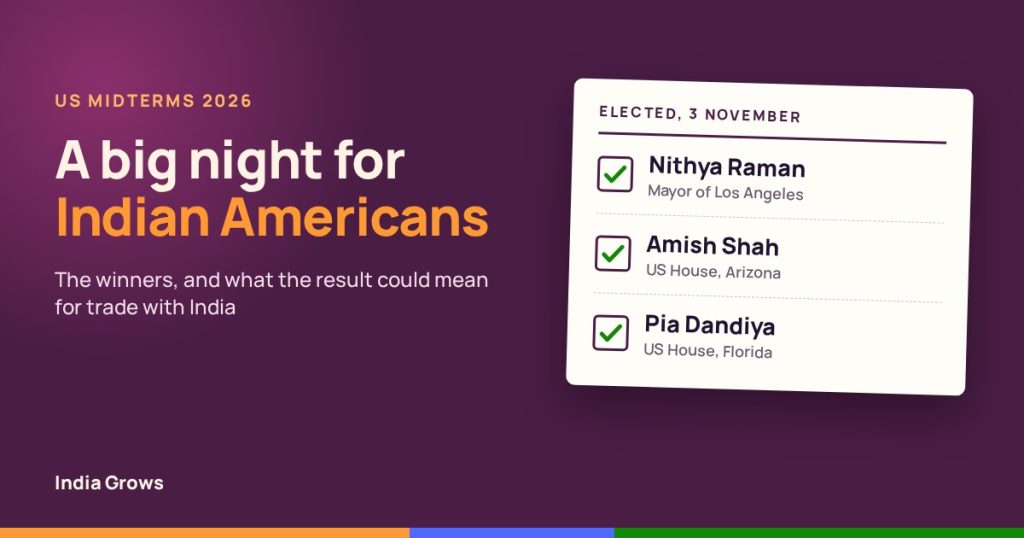
The United States voted on 3 November, and the results matter to the Indian diaspora in two ways. Indian Americans won some of the most closely watched races in the country, including the mayor’s office in Los Angeles. And the shift in power in Washington is already changing how analysts in India read the long-running trade talks. Here is what happened and why it matters for diaspora businesses.
At a glance
- Los Angeles: Councilwoman Nithya Raman beat Mayor Karen Bass and will be the city’s first South Asian mayor. Bass conceded on 5 November.
- US House: newcomers Amish Shah (Arizona) and Pia Dandiya (Florida) won, and four sitting members were re-elected. That appears to keep the Indian American group in the House at six, despite two members leaving.
- Ohio: Vivek Ramaswamy lost the race for governor to Democrat Amy Acton.
- Congress: the Associated Press has called both the House and the Senate for the Democrats, with some races still being counted.
- Trade: a report from Emkay Global says the urgency of a US trade deal has faded for India. Indian goods currently face a 10% additional US duty.
1. Los Angeles elects its first South Asian mayor
Nithya Raman, a member of the Los Angeles City Council since 2020, trailed on election night but moved ahead as later ballots were counted. Karen Bass conceded on Thursday 5 November. Bloomberg, citing the Associated Press tally, put Raman on 52.1% and Bass on 47.9%. Ballots are still being counted and certification is due on 11 December, so those figures may change.
Raman, a member of the Democratic Socialists of America, will lead a city with a budget of about $14 billion. LAist reports that her first decisions include affordable housing in single-family neighbourhoods, homelessness, police reform and the rebuilding permits that follow the Palisades Fire.
What it means: for diaspora business owners in the city, especially in property and construction, housing and permit decisions will be the ones to follow first. We have not seen a detailed business plan from the new mayor, so it is too early to say how any of this will affect costs.
2. Who won and who lost
Two new names are heading to Congress:
- Amish Shah, a former Arizona state lawmaker and emergency room doctor, beat Republican Jay Feely in Arizona’s 1st District. The seat was open and had been held by a Republican. The Associated Press called the race on 5 November, with Shah on about 52% to 53%. The American Bazaar describes him as the first Indian American elected to the US House from Arizona.
- Pia Dandiya, a former teacher and school principal, beat Republican Casey Askar in Florida’s 22nd District, which had been redrawn and backed Donald Trump in 2024. She took about 52% in the NBC News and New York Times tallies, although a local report gave a higher figure. She is reported to be the first South Asian American to represent Florida in Congress.
Four sitting members of the House were re-elected: Ami Bera (California), Ro Khanna (California), Pramila Jayapal (Washington) and Suhas Subramanyam (Virginia). Raja Krishnamoorthi and Shri Thanedar will leave the House: Krishnamoorthi gave up his seat to run for the Senate and lost the primary in March, and Thanedar lost his party’s primary in August. So the group loses two members and gains two.
Beyond Congress, Aruna Miller won another term as Lieutenant Governor of Maryland, and Nabeela Syed took a Republican-held Illinois state Senate seat.
It was not a clean sweep. The biggest loss was Vivek Ramaswamy, the Trump-backed Republican candidate for Ohio governor, who was beaten by Democrat Amy Acton despite outspending her. Republican Mahesh Ganorkar lost in North Carolina, and Republican Ritesh Tandon lost to Ro Khanna in a contest between two Indian Americans.
3. What the new Congress could mean for trade with India
As of Friday 6 November, the Associated Press tally had Democrats on 253 House seats to the Republicans’ 157, with 25 races uncalled. In the Senate it had Democrats on 54 and Republicans on 44, with Alaska and Mississippi still undecided. New members take their seats on 3 January 2027.
In a report carried by the news agency IANS on 5 November, the brokerage Emkay Global argues that the urgency of a trade deal has faded for India. Its reasoning is that:
- the 18% tariff rate in the February framework was never put in place;
- the US has lost the emergency economic powers it used for earlier tariffs, so new ones must go through slower investigations under Section 301 and Section 232 of US trade law; and
- the election result is unlikely to change the tariff structure much, but it does change the incentives, with more pressure on affordability for US consumers.
That is one firm’s view, not government policy. It also sits awkwardly with US Secretary of State Marco Rubio’s comment in Mumbai on 20 October that a deal was “very, very close”, which we covered in our earlier article on the talks. We did not find any new statement from India’s commerce ministry since the election.
What it means: India’s Press Information Bureau says the current additional duty is 10%, imposed under a Section 301 forced-labour investigation, down from the 12.5% first proposed in June. Emkay names two main risks: Section 232 tariffs on particular sectors such as pharmaceuticals and electronics, and any setback in Russia or Iran diplomacy that renews pressure over India’s oil imports.
4. Oil and the rupee
Emkay says Brent crude has fallen about 19% from its October high to around $95 a barrel, which eases pressure on India’s import bill. The rupee was trading at around 94 to the dollar this week, compared with about 95 when we wrote our roundup on 27 October. Emkay expects the Reserve Bank of India to use any lasting inflows to rebuild its reserves, which would limit how far the rupee can rise. That matters if you send money to India or price contracts in rupees.
What to do now
- If you export to the US, ask your customs broker how your exact product code is treated. The 10% duty does not apply in the same way to every product.
- If you sell pharmaceuticals or electronics, watch for Section 232 announcements, as these are the sector risks Emkay highlights.
- Do not plan around a trade deal date. The signals differ, so price your contracts on the tariffs that apply today.
- If you do business in Los Angeles, follow the new mayor’s first housing and permit decisions before committing to new projects.
Where to start
Looking for partners in the US, or in India? Browse live deals, post your own, or find accountants, lawyers and advisers of Indian origin who can help with the detail.
Sources
- Press Information Bureau, Government of India: US Section 301 measures
- IANS: Emkay Global report on the trade deal
- LAist: Los Angeles mayoral result
- Bloomberg: Raman’s win and vote share
- KJZZ: Arizona’s 1st District result
- NBC News: Florida’s 22nd District results
- Axios: Ohio governor result
- The American Bazaar: Indian American winners
- Yahoo News: control of Congress, Associated Press tally
Last updated 6 November 2026. Based on news reports and a government release available that day. Many US results are preliminary and not yet certified, and figures may change. India Grows does not support any candidate or party.